THU, OCT 1
Canterbury, England
Arrival day
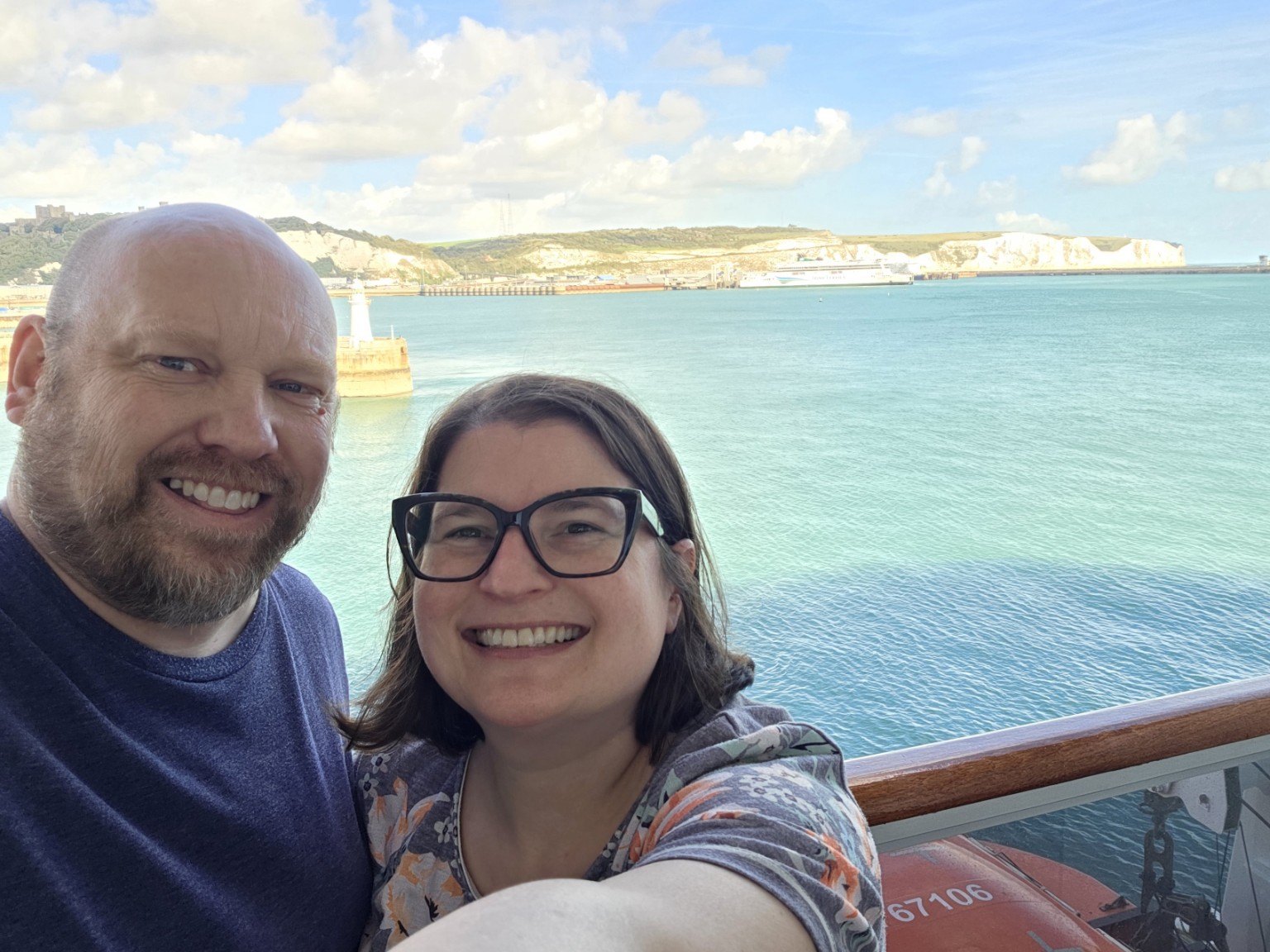
Fourteen nights aboard Nieuw Statendam, sailing round-trip from Dover through Madeira, the Canary Islands, and Lisbon, followed by three days exploring Ireland.
EXPLORE THE ITINERARY18 DAYS
October 2-19, 2026
NIEUW STATENDAM
Our home at sea
IRELAND FINALE
Three nights exploring Ireland
ONE JOURNAL
Every memory together
THE ROUTE
Eight ports, six sea days, and an Irish finale.
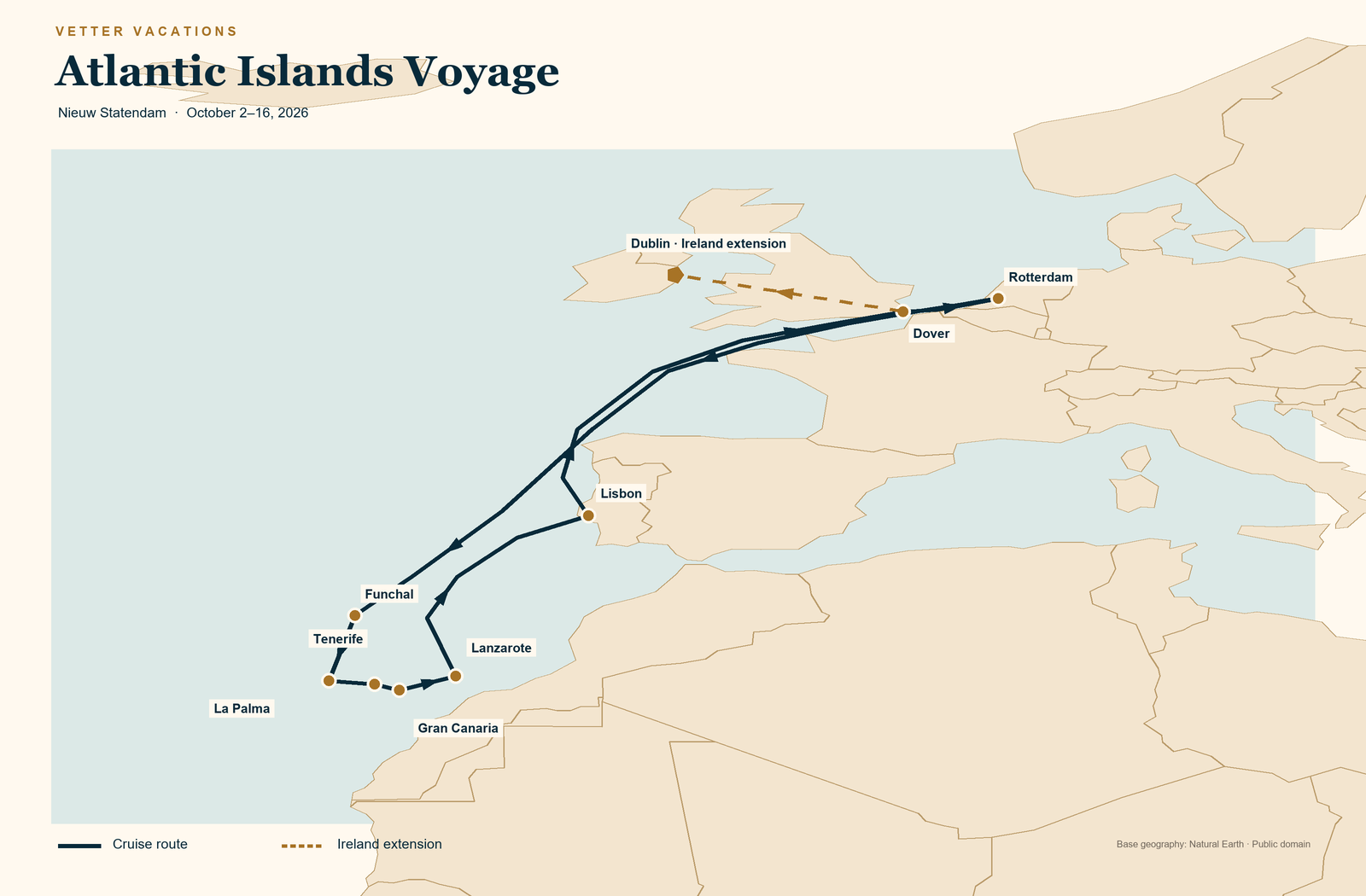
THE JOURNEY
Dover to the islands, then three days exploring Ireland.
THU, OCT 1
Arrival day
FRI, OCT 2
Departs 6:00 pm
SAT, OCT 3
7:00 am - 3:00 pm
WED, OCT 7
9:00 am - 6:00 pm
THU, OCT 8
10:00 am - 9:00 pm
FRI, OCT 16
Arrives 7:00 am
SAT-MON, OCT 17-19
Dublin, Galway, Clonmacnoise & more
Port times are subject to change. Please use the ship’s daily program for final timing.
OUR TRAVELS
A day exploring Tenerife, from the city streets to the volcanic landscapes around Mount Teide.
Mount Teide rising above Tenerife’s rugged volcanic landscape, beneath a clear blue sky.
Nate and Nichole taking in the volcanic scenery on Tenerife.
Lanzarote’s dark volcanic earth, low stone walls, and bright white buildings made this stop feel unlike anywhere else on the trip.
Vines grow in hollows in the dark volcanic ground, with curved stone walls providing shelter.
A closer look at one of Lanzarote’s vines, surrounded by volcanic gravel and protected by a low stone wall.
Nate and Nichole exploring Lanzarote’s volcanic landscape.
A line of saddled camels waiting against Lanzarote’s volcanic hills.
A moment from our day in Lisbon, exploring its streets, viewpoints, waterfront, and ornate buildings.
Nate and Nichole above Lisbon, with the city and harbor behind us.
A panorama of Lisbon’s terracotta rooftops, with church domes rising above the city.
One of Lisbon’s yellow trams winding through a street lined with colorful buildings.
A close look at the patterned blue tiles decorating a Lisbon building.
Our chocolate stop in Lisbon: Landeau Chocolate, the café founded by Sofia Landeau and known for its signature chocolate cake. Its original location is at LX Factory, a former industrial complex in the Alcântara neighborhood. The airy interior pairs exposed steel and tall windows with vintage furnishings. Sources: Landeau Chocolate; Time Out Lisbon; Lisboa Cool.
The cake that brought us to Landeau: a dense chocolate base, a light mousse-like chocolate layer, and a generous dusting of cocoa. Created by Sofia Landeau, it has earned international attention; The New York Times described it as “devilishly good,” and food writer Dorie Greenspan developed her own Lisbon Chocolate Cake after tasting it here. Sources: Lisboa Cool; The Brick Kitchen; Dorie Greenspan’s Lisbon Chocolate Cake recipe.
Belém Tower beside the Tagus, with its stone turrets standing out against the blue sky.
Our first stop in Ireland after the cruise, with time to settle in and explore Dublin.
Nate and Nichole enjoying a quiet moment in Dublin.
The Conrad Dublin, our hotel for the first night of our Ireland stay.
We stopped at Clonmacnoise beside the River Shannon, wandering among old stone churches, carved crosses, and open views across the grounds.
Clonmacnoise was founded by St. Ciarán around AD 548, making this monastic site nearly 1,500 years old. It began as a Christian community devoted to prayer and religious life, and grew into an important centre of learning, craftsmanship, trade, and pilgrimage. Its position where the River Shannon met a major east–west land route helped it flourish. The first churches were wooden; stone churches followed from the 10th century onward, so the surviving ruins span many different periods. After centuries of raids and gradual decline, the settlement was devastated by the English garrison from Athlone in 1552.
The largest church at Clonmacnoise began as a stone cathedral built in AD 909 with the support of Abbot Colmán and King Flann Sinna. Parts of that original building survive alongside later medieval alterations—more than 1,100 years of history in these walls.
Nate and Nichole among the monastery ruins at Clonmacnoise.
Clonmacnoise became a renowned place of study, attracting students from across Europe. The surviving churches, round towers, carved high crosses, and early Christian grave slabs reflect its role as a religious and educational centre. Original high crosses are protected indoors, with replicas standing outside.
These are the remains of Clonmacnoise Castle, a separate medieval fortress beside the monastery. Built in 1214 by the chief governor of Ireland, it is more than 800 years old. A stone hall and courtyard formed its core, with timber defenses on the surrounding banks. It may have been deliberately destroyed as early as 1300.
Nate and Nichole out for an evening in Galway.
An evening in Galway, where colorful shopfronts and warmly lit streets set the scene for a wander through the city.
Our visit to Ireland’s dramatic Atlantic coastline, with sheer cliffs, green fields, and views out to sea.
The Cliffs of Moher dropping steeply into the Atlantic, with green grass tracing the edge above.
Nate and Nichole at the Cliffs of Moher on Ireland’s Atlantic coast.
A stop in Limerick to explore the castle and the city beside the River Shannon.
Looking along the River Shannon and across the bridge in Limerick.
Nate and Nichole taking in the views from King John’s Castle in Limerick.
The statues of Barack and Michelle Obama outside Barack Obama Plaza in Moneygall, Ireland.
Nate and Nichole posing with the Barack and Michelle Obama statues at Barack Obama Plaza in Moneygall, Ireland.
Our room at Carton House for the final night of the trip.
A row of old service bells inside Carton House, each linked to a different room.
Carton House in Maynooth was the country seat of the FitzGerald family, the Earls of Kildare and later Dukes of Leinster. In 1739, the 19th Earl commissioned architect Richard Cassels (also known as Richard Castle) to create the grand house—giving its main 18th-century design nearly 290 years of history by our visit. Built as an aristocratic family home, it hosted generations of family life and entertaining before becoming the hotel we stayed in on our final night in Ireland.
A low stone bridge reflected in the still water on the Carton House estate.
La Palma’s steep coastal slopes rise above the harbor as we arrive for our island visit.
Our ship in the harbor, with the Atlantic and Santa Cruz de La Palma stretching beyond the hillside.
Clouds settle along the ridges above La Palma’s green interior during our drive across the island.
Dark volcanic rock, island greenery, and a glimpse of the Atlantic during our volcano visit.
A path between dark volcanic rocks and hardy island plants.
A closer look at the plants growing among La Palma’s dark volcanic rocks.
Together on La Palma, with the volcanic cone rising behind us during our October 8 visit.
The cone formed during La Palma’s 2021 eruption. Activity began on September 19 and ended on December 13, lasting about 85 days, according to Spain’s National Geographic Institute.
A wall of rugged lava rises beside the road—a striking view of La Palma’s volcanic landscape.
Homes and green fields stretch toward the Atlantic beneath La Palma’s cloud-covered slopes.
Dark lava stands close beside a house and road—a striking view from our drive through the eruption area.
An excavator stands on the dark lava field beside fenced land during our visit.
A wide expanse of dark volcanic rock with the Atlantic on the horizon.
A quiet house stands beside the volcanic landscape, with the sea beyond.
Dark lava surrounds a tiled-roof house, showing how closely the eruption affected the island’s neighborhoods.
A closer look at the cone from our visit to the volcano formed in La Palma’s 2021 eruption.
Rough lava fills the foreground beneath clouds and distant mountain slopes.
A bunch of green bananas hangs among broad leaves behind a stone wall.
The colorful Ruta 22 American Diner sign, spotted during our day on La Palma.
A barraquito coffee break during our La Palma stop. This layered coffee originated in the Canary Islands, particularly Tenerife, and is traditionally made with condensed milk, coffee, milk, liqueur, cinnamon, and lemon peel.
A decorative street cover bearing the name Santa Cruz de La Palma and a crest—a small detail worth noticing.
A banana break while exploring Santa Cruz de La Palma. Canarian bananas, known as plátanos, are famous for their sweet flavor and little brown speckles. The islands’ mild subtropical climate lets them develop slowly on the plant and build up the natural sugars that give them their characteristic sweetness.
A favorite photo together, with Madeira’s steep coastline and the Atlantic stretching out behind us.
A sweep across Funchal’s waterfront, with the city climbing into the mountains behind the harbor.
A panorama of Funchal’s hillside neighborhoods, green slopes, and the Atlantic beyond.
Small fishing boats bob in the sheltered harbor, framed by the village and rocky shoreline.
The Cristiano Ronaldo museum sign on Funchal’s waterfront.
The bronze Cristiano Ronaldo statue beside Funchal’s harbor.
Sunshine on the Atlantic beneath Madeira’s rocky cliffs.
A closer look at the steep coastal slopes and the sea below.
Nate and Nichole beneath the outstretched arms of the Cristo Rei statue.
The statue stands with its arms extended above Madeira’s coastline.
Hydrangeas frame the hillside rooftops and a glimpse of the Atlantic.
Nate and Nichole with hillside neighborhoods and the Atlantic behind us.
A red-roofed church and bell tower against the deep blue ocean.
Homes and terraced hills rise toward the mountains beneath low clouds.
A striped bell tower stands above red-tiled roofs and hillside homes.
Spreading branches offer a shady pause during our Madeira day.
Brightly painted fishing boats pulled up beside the harbor.
A red, white, and blue wooden boat rests beside the harbor wall.
Buildings perch on rocky slopes above the calm water.
Small boats dot the water beneath a bright, cloud-filled sky.
A colorful fishing boat with “Funchal” painted on its hull.
Bright decorations stretch across a narrow cobbled street.
A colorful street and a quick photo together during our Madeira day.
Painted ceilings, gilded details, and wooden pews inside a Madeira church.
A closer look at the ornate painted ceiling and gilded decoration.
A devotional statue framed by elaborate gold-colored carving.
Bottles labeled tangerine, passion fruit, and regional poncha.
A bright orange drink and a patterned tabletop during our Madeira stop.
A dark-hulled sailing ship rests on the water beneath a cloudy sky.
Shops and cafés line a narrow street decorated overhead.
The sign beneath our feet marks the height of Cabo Girão’s glass viewing platform: 580 meters above sea level.
Our shoes on the Cabo Girão skywalk, with the cliffside and ocean visible through the glass beneath us.
Terraced slopes, clifftop neighborhoods, and a sweeping stretch of Madeira’s coast.
A wide view along Madeira’s dramatic coastline, with terraced fields, hillside homes, and the Atlantic beneath a changing sky.
Designed by Piet Blom and built between 1982 and 1984, Rotterdam’s Cube Houses turn ordinary homes into an extraordinary streetscape. Their tilted yellow cubes are one of the city’s best-known landmarks.
A wider view of Piet Blom’s Cube Houses at Overblaak, with their yellow walls and angular roofs.
The Cube Houses seen from street level: every angle reveals a different arrangement of windows, roofs, and yellow panels.
A Rotterdam memory together, with the city’s unmistakable yellow Cube Houses behind us.
Opened on October 1, 2014, the Markthal was designed by MVRDV to combine a covered food market with homes in its enormous arch. It is a striking meeting of everyday shopping and adventurous architecture.
Rows of parked bicycles near Blaak—a very Dutch city scene beside Rotterdam’s architectural landmarks.
Wheels and wedges of cheese at the outdoor market beside the Markthal.
Neatly stacked trays of eggs at the outdoor market beside the Markthal.
Bright tulips and colorful blooms among the outdoor market stalls.
The fish stall at the outdoor market, with the day’s selection laid out on ice.
Built between around 1449 and 1525, the Laurenskerk is Rotterdam’s surviving late Gothic landmark from the medieval city. Its centuries-old stonework offers a striking contrast to the modern buildings nearby.
The pointed roof gives the Blaaktoren its nickname, “The Pencil.” Designed by Piet Blom, it forms part of the same architectural ensemble as the Cube Houses, completed in 1984.
A colorful display of spices inside Rotterdam’s Markthal.
Inside the Markthal, the huge ceiling artwork “Horn of Plenty,” by Arno Coenen and Iris Roskam, surrounds the market with oversized fruit, flowers, and food imagery.
Unox hot dogs spotted during our Rotterdam visit.
A herring stall at the outdoor market: “haring” is Dutch for herring.
A display of dishes inside the Market Hall—just a few of the many food options.
The Duck Truck food counter inside the Markthal.
A closer look at the outdoor herring stall’s menu, with rolls and traditional accompaniments.
The Markthal peeks out beyond the surrounding streets and buildings.
A sharply angled modern building rises beside Rotterdam’s waterfront—another example of the city’s adventurous skyline.
Looking out over Rotterdam’s waterfront from Nieuw Statendam.
A sunny waterfront photo together during our Rotterdam stop.
The water, boats, and high-rise skyline that give Rotterdam its maritime character.
The capsule-shaped glass penthouse above Las Palmas seems to float over the roof on slender columns. Benthem Crouwel designed the renovation and rooftop addition, which opened in 2007.
One of the tall residential buildings framing the waterfront around the cruise terminal.
Hotel New York occupies the former headquarters of Holland America Line, dating from 1901. The building became a hotel and restaurant in 1993—a lovely connection to the cruise line taking us on this voyage.
This gleaming spiral is the Tornado at Fenix, Rotterdam’s art museum about migration. Designed by Ma Yansong of MAD Architects, it leads to a rooftop viewpoint. Fenix opened to the public on May 16, 2025.
The Montevideo residential tower, completed in 2005, is one of the prominent buildings on Rotterdam’s Wilhelminapier.
A closer look at Hotel New York’s historic brickwork and green tower, framed by the modern waterfront skyline.
Traditional English breakfast at the Dover Marina Hotel on the morning of October 2, before boarding Nieuw Statendam.
The White Cliffs of Dover get their striking white color from chalk—a soft limestone formed from the remains of tiny marine organisms in an ancient sea. A beautiful backdrop as our Atlantic voyage begins.
Dover Castle has guarded the English Channel for centuries. Much of the medieval fortress we see today was built under King Henry II in the late 12th century: work on its Great Tower and inner bailey began in 1179 and was largely complete around 1189. Later generations strengthened its defenses and added tunnels, adapting the site for warfare into the 20th century.
Founded by St Augustine in AD 597, Canterbury Cathedral was rebuilt by Archbishop Lanfranc between 1070 and 1077. The building we see today grew through centuries of rebuilding and additions. Canterbury Cathedral is closely tied to Thomas Becket, its medieval archbishop. Once an ally of King Henry II, Becket clashed with the king over the Church’s independence. On December 29, 1170, four knights murdered him inside the cathedral. He was later declared a saint, and his shrine made Canterbury one of medieval Europe’s great pilgrimage destinations. That pilgrimage tradition also inspired Geoffrey Chaucer’s The Canterbury Tales, written in the late 14th century. Its characters travel from London to Canterbury to visit Becket’s shrine, telling stories along the way.
Among Canterbury’s historic streets stands a First World War memorial, honoring those who lost their lives in the conflict—a quiet reminder of the sacrifices behind this peaceful city scene.
Christ Church Gate has welcomed visitors into Canterbury Cathedral’s grounds for more than 500 years. Completed around 1520, this Tudor Gothic gateway is decorated with intricate carvings and Tudor coats of arms. Its restored stonework and gilded details make it a striking entrance from the city into the cathedral precincts.
The Canterbury War Horse remembers the human and animal lives lost in conflict. According to the nearby sign, more than eight million horses died in the First World War, and many passed through Kent on their way to the continent. The horse’s bowed head conveys respect and solemn remembrance. The sculpture was a collaboration between Canterbury Cathedral and the Canterbury School of Visual Arts at EKC Canterbury College, bringing together students, academics, and the college’s technical and engineering teams.
Our hotel for the night in Dover, October 1–2, before boarding Nieuw Statendam for our Atlantic voyage.
Lunch at The Corner House in Canterbury was amazing.
Two weeks of Atlantic light, island ports, long dinners, and the kind of days we will talk about for years.
VETTER VACATIONS
A private home for the itinerary, the little discoveries, and every photograph we will want to revisit.